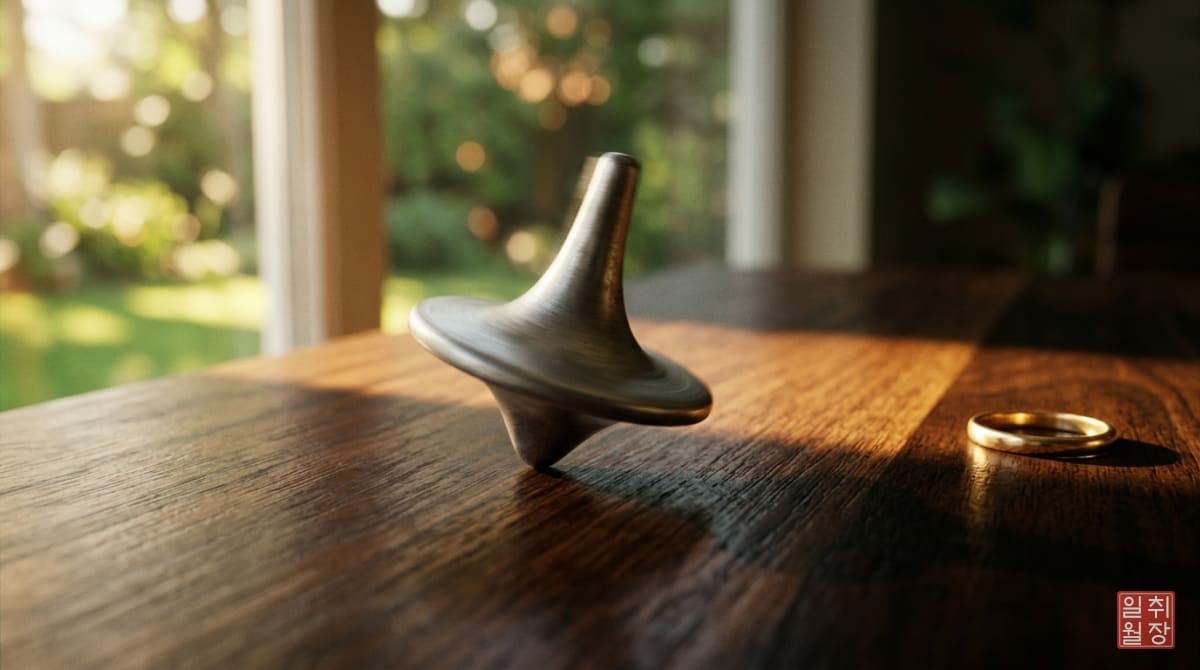
A pewter top spins across a sunlit wooden dining table, wobbles for a fraction of a second, and—cut to black. Over a decade after theaters collectively gasped in 2010, the spinning top ending of Inception remains one of the most searched questions in modern cinema: did Dom Cobb make it back to reality, or is he still trapped inside a dream?
The short answer is reality. Multiple on-screen production details, the film’s official end credits, and direct statements from cast and crew all converge on the same conclusion—and the spinning top we were all staring at wasn’t even Cobb’s real totem.
Spoiler Warning
This article breaks down the ending, core plot twists, and character arcs of Inception (2010). If you haven’t watched the film yet, save this read for after the credits roll.


Christopher Nolan
Director · Writer

Leonardo DiCaprio
Dom Cobb
Michael Caine
Prof. Stephen Miles

Marion Cotillard
Mal Cobb
⚡ Quick Summary: 5 Clues That Settle the Inception Ending
To separate fan speculation from documented production facts, here is how the five main pieces of evidence line up.
| Clue | On-Screen Detail & Production Fact | Verdict | Source Type |
|---|---|---|---|
| 1. Prof. Miles’s Presence | Nolan told Michael Caine directly: “When you’re in the scene, it’s reality.” Miles is in the final scene. | Reality | Actor Confirmation (2018) |
| 2. Child Actors in Credits | Phillipa (5) and James (3) in the finale are played by older actors than in the dream memories (3 & 20 mos.). | Reality (Time Passed) | Official End Credits |
| 3. Cobb’s Wedding Ring | Cobb wears a wedding band on his left hand only in dreams; his hand is bare in the final reunion. | Reality | Visual Continuity Detail |
| 4. The Top’s Wobble | The axis tilts and friction sound rises right before the cut (though the top itself is a flawed totem). | Leans Reality | Editing & Sound Design |
| 5. Cobb Walking Away | Cobb stops watching the top and turns toward his children, choosing his lived reality over obsession. | Emotional Resolution | Christopher Nolan Interviews |
The Spinning Top Trap: Why Cobb’s Real Totem Is His Wedding Ring
Most debates fixate on a single binary—if the top falls, it’s real; if it spins forever, it’s a dream. Yet by the rules established inside the movie’s own screenplay, the spinning top shouldn’t even work as Cobb’s totem.
Why Mal’s Pewter Top Breaks Every Rule of a Totem
Early in the film, Arthur (Joseph Gordon-Levitt) explains the strict ground rules of a totem to Ariadne: it must be a small personal object whose exact weight, balance, and feel only you know. The moment someone else touches it, they can replicate its physics inside a dream they design, rendering the totem useless.
Arthur uses a loaded die; Ariadne hollows out a brass chess bishop. Notice how both work: in reality, they behave according to their secret modification, whereas inside someone else’s dream, they behave like ordinary objects.
Cobb’s pewter top violates this logic twice over:
- It never belonged to Cobb: The top originally belonged to his late wife, Mal (MMarion Cotillard(Mal)). Not only did Cobb handle it when he broke into her safe in Limbo, an aged Saito also picks it up and spins it in the Limbo dining room framing the film. Multiple people know its weight and feel.
- Its physics work backward: You cannot build a top that spins forever in the real world. Rather than detecting whether Cobb is inside someone else’s dream, the top is really a relic of Mal’s tragedy—an object Cobb compulsively spins out of guilt to check whether physics still apply.
Watch His Left Hand: The Wedding Ring Theory
If the top is a red herring, what actually tracks Cobb’s state across the film? Look closely at the left ring finger of Dom Cobb (LLeonardo DiCaprio): his wedding band.
Because Cobb cannot forgive himself for Mal’s death, his subconscious refuses to let her go. In every single dream layer—the rain-soaked streets, the hotel hallway, the mountain fortress, and Limbo—Cobb wears his wedding ring. In every waking reality scene—Tokyo, Paris, Mombasa, Yusuf’s basement pharmacy, the Boeing 747 cabin, and customs in Los Angeles—his left hand is bare.
When Yusuf puts Cobb under in the Mombasa basement to test his sedative, Nolan frames a quick shot of Cobb waking up and checking his bare hand by the sink. In the final sequence, as Cobb hands over his passport and later scoops up his kids in the backyard, there is no ring on his left hand.
Four visual and structural contrasts between the dream layers and the ending—the ring, the children’s ages, and Prof. Miles all point to reality.
Two Official Confirmations: Michael Caine and the Cast Credits
While the wedding ring clue comes from meticulous frame-by-frame analysis, two pieces of production evidence come straight from the filmmakers and the cast list.
1. Michael Caine’s Rule Straight from Christopher Nolan
Eight years after Inception hit theaters, MMichael Caine(Prof. Miles)—who plays Cobb’s father-in-law and mentor, Professor Stephen Miles—settled the question at a Film4 Summer Screen outdoor presentation at Somerset House in London in August 2018.
Caine recalled being puzzled when he first received the script and asking Nolan directly how to tell the dreams apart from real life:
“When I got the script of Inception, I was a bit puzzled by it, and I said to him, ‘I don’t understand where the dream is. When is it the dream and when is it reality?’ He said, ‘Well, when you’re in the scene, it’s reality.’ So get that—if I’m in it, it’s reality. If I’m not in it, it’s a dream.” — Michael Caine, Film4 Summer Screen Q&A (August 2018)
True to Nolan’s direction, Professor Miles only appears in three places across the entire movie: the university lecture hall in Paris where Cobb recruits Ariadne, the Los Angeles airport arrival gate, and the living room of Cobb’s house in the finale. Because Miles walks Cobb into the house to see his grandchildren, the ending is unambiguously reality by Nolan’s own on-set rule.
2. Check the End Credits: Two Different Pairs of Child Actors
Skeptics who argue the entire movie is a dream often claim that Cobb’s children, Phillipa and James, haven’t aged a day and are wearing the exact same clothes in the exact same garden pose from Cobb’s memories.
A quick look at the official end credits disproves that claim. Nolan cast two separate pairs of child actors at different ages:
- Memories & Dream Projections: Phillipa (3 Years — played by Claire Geare) and James (20 Months — played by Magnus Nolan, the director’s youngest son)
- Final Backyard Reunion: Phillipa (5 Years — played by Taylor Geare, Claire’s older sister) and James (3 Years — played by Johnathan Geare)
Costume designer Jeffrey Kurland dressed the older pair in similar warm plaid and pastel tones to echo Cobb’s memory at first glance, but their shoes, outfits, and heights are noticeably different—and for the first time in the film, they turn around so we clearly see their faces.
Édith Piaf’s “Kick” and Why Nolan Cut to Black Anyway
If Nolan planted so many concrete clues proving Cobb made it home, why cut to black right before the top tumbles?
Hans Zimmer’s Brass Trick and a Final “Kick” for the Audience
Throughout the heist, the team uses Édith Piaf’s French chanson “Non, Je Ne Regrette Rien” (“No, I Regret Nothing”) as the kick—the audio cue played through headphones to warn dreamers that time is up.
Composer Hans Zimmer famously engineered Inception’s thunderous signature brass blast (BWAAAAH) by taking two horn notes from Piaf’s recording and slowing them down dramatically, baking the film’s time-dilation math (where minutes in reality stretch into hours and years down below) directly into the score.
At the very end of the closing credits, Piaf’s track resurfaces one last time before dropping into a final resonant boom. It acts as a playful meta-kick aimed at the audience: after 148 minutes inside the shared dream of a darkened movie theater, it’s time to wake up and step back out into the real world.
Why the Ambiguity Belongs Only to the Audience
CChristopher Nolan(Director) has addressed the final cut directly—most notably in his 2015 Princeton University commencement speech (“chase your reality”) and again in a July 2023 interview with Wired during the Oppenheimer press tour:
“There is a nihilistic view of that ending, right? But also, he’s moved on and is with his kids. The ambiguity is not an emotional ambiguity. It’s an intellectual one for the audience.” — Christopher Nolan, Wired (July 2023)
For two hours, Cobb is a man ruled by paranoia and grief, unable to trust a room until he spins Mal’s top and watches it stop. In the final scene, he spins the top out of habit—and then hears his children, turns his back on the table, and walks outside without waiting for the result.
Watching Sci-Fi & Tentpole Epics in Premium Formats
From Inception and Interstellar to IMAX-shot epics like The Odyssey and Dune: Part Three, sound design and aspect ratio carry half the storytelling weight. If you are planning theater trips for upcoming tentpoles, check out our Late 2026 Blockbuster & Premium-Format Guide.
Had the camera lingered another two seconds to show the pewter top clattering flat on the wood, the puzzle box would have clicked shut, but the character’s breakthrough would have felt smaller. Whether the top wobbles down a split second later is beside the point to Cobb: for the first time since losing Mal, the life standing right in front of him is enough.
